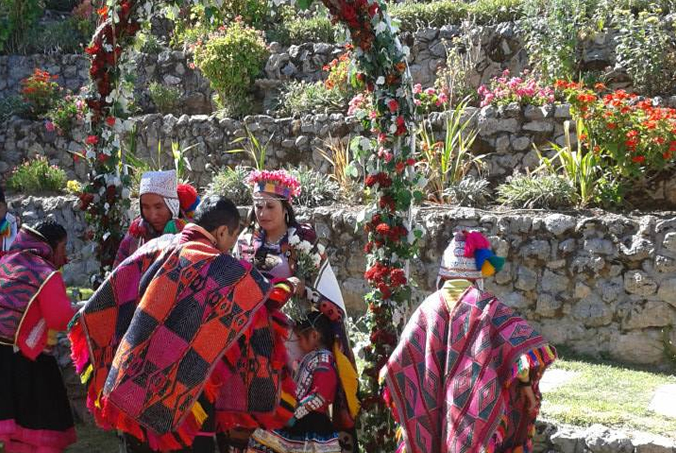
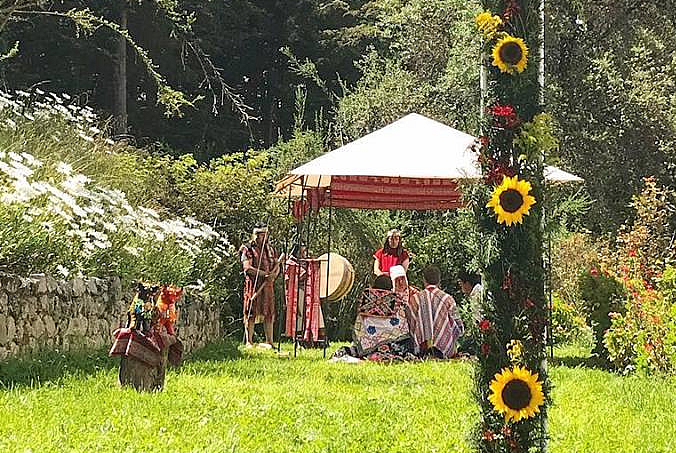
The inhabitants of The Andes, following their traditions, consecrate their marriage to the Pachamama or Mother Earth in a special ceremony.
This is a manifestation our living culture.
The ritual starts by using incense and flower essences to “clean” the couple, as a symbol of the beginning of a new life.
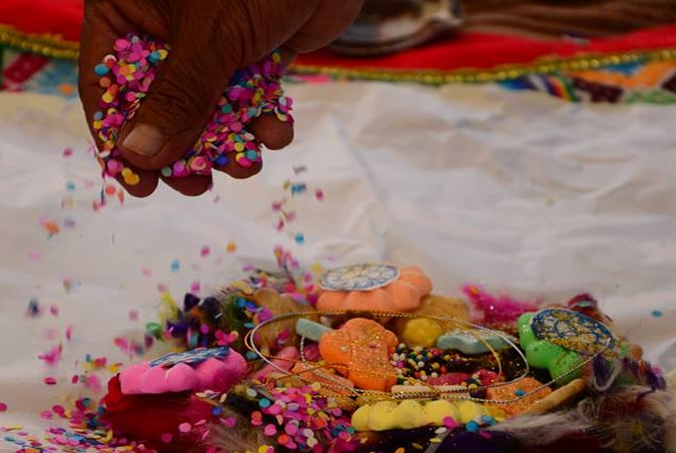
Immediately, an offering to the Pachamama is prepared as a sign of gratitude for the blessings she provides us every day, including the joy of having reunited the couple.
Several elements are included in the offering: seeds, sweets, flowers, colored wool and others representing the Andean World. Also metals, animal fat and drinks (corn beer “chicha”, for example)
The celebrant is a shaman, an Andean sage, who will pray and ask for the wellbeing of the couple celebrating their union.
Couples actively participate in the ceremony and if close relatives are present they also ask for the welfare of the couple and their descendants.
This is a symbolic ceremony of great significance in the Andean world that some travelers are encouraged to perform to commemorate their anniversary and/or renew their marriage vows.
The ceremony is in Quechua, our native language and an interpreter is involved to facilitate the communication between the participants.
At Casa San Blas Boutique, hotel in Cusco, we will be happy to organize this unforgettable experience for our guests. Choose the Loraipo room dedicated to the «love couple» or one of our beautiful suites with city view.
We will organize this ceremony at La Casona Princesita www.laprincesitaeventos.com, one of our sister companies in Cusco.
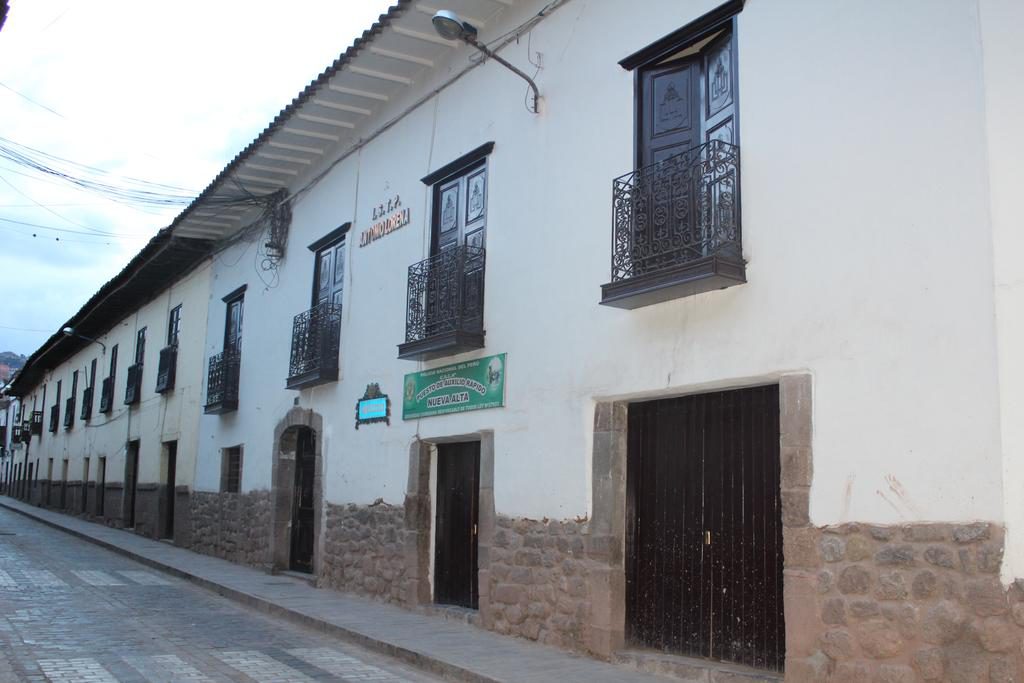
San Blas, also known as the artisans’ quarter, is undoubtedly one of the most important attractions within the city of Cusco.
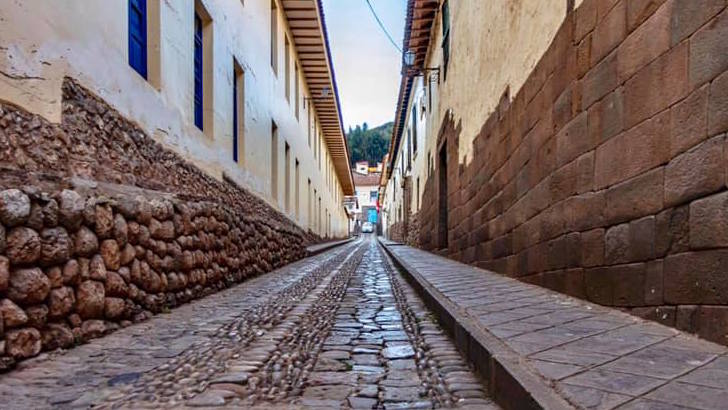
Its narrow cobbled streets, its colonial houses, its church with its wooden pulpit, its workshops, its art galleries, its coffee shops, its restaurants, its people and its colors are a clear example of our miscegenation.
Until the 90s, the main attraction of San Blas were its picturesque streets and artisan workshops.
It was common for children from local schools, at least once a year, to visit the workshops of the Mendivil, Aguayo, Merida and Olave families, as part of their curriculum.
These artists were very illustrious personalities and their art was recognized throughout the city.
Don Hilario Mendivil
He was born in Cusco at the beginning of the twentieth century, was one of the most famous craftsmen in Cusco. His work is known for creating images of saints, virgins and angels with a serene face and long necks.
Although they are religious works, Don Hilario Mendivil prints on each of his works his personal seal.
Don Hilario died very young, at age of 50, leaving the whole family his legacy: the art of imagery. Today, his workshop and gallery can be visited at the Plazoleta de San Blas 364, Cusco – Peru.
Don Luis Aguayo
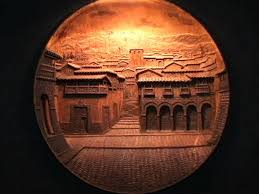
This famous artist is one of the main exponents of the art of wood carving. His work reflects traditional landscapes and streets of the city.
Don Luis Aguayo defines himself as an artist passionate about Cusco and therefore puts all his skill in portraying Cusco through his reproduction in miniature streets, landscapes and archaeological remains.
Don Luis’ work has a little more than half a century and also includes canvases. He is a great artist whose works are exhibited in Cuesta del Almirante 266, half a block away from the Plaza de Armas of Cusco – Peru.
Don Edilberto Merida
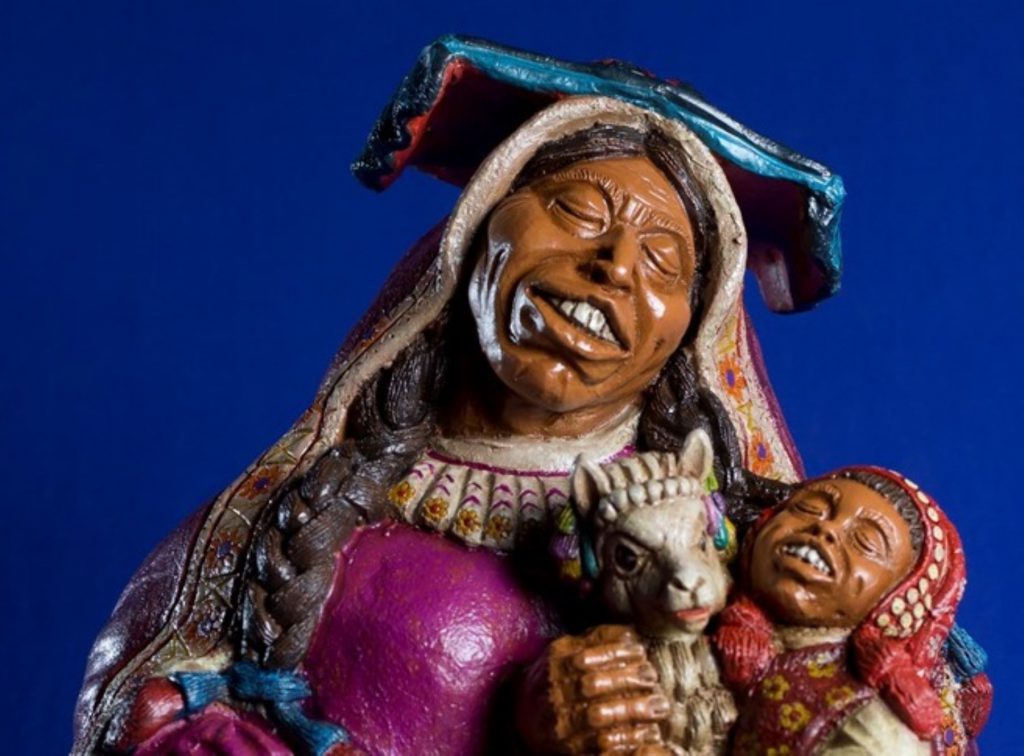
He was born in the San Cristobal neighborhood. He worked from a very young age as a carpenter until in 1961 when he began to create clay figures with a strongly expressionist style that portray the pain of forced labor of the indigenous.
He was known as the sculptor of the “protest mud”, his works show a deep social content and reflect the daily life and the difficult geographical environment of the Andes.
Within his works, the crucified and suffering Christ are famous, as well as other figures representing the poverty of the land workers in Peru
His daughter, Mrs. Antonieta Mérida follows her legacy. His works are exhibited at Calle Carmen Alto 133 San Blas, Cusco – Peru.
Don Antonio Olave
He was born in Pisaq (Calca – Sacred Valley) in the early twentieth century is probably one of the most famous artists in Cusco.
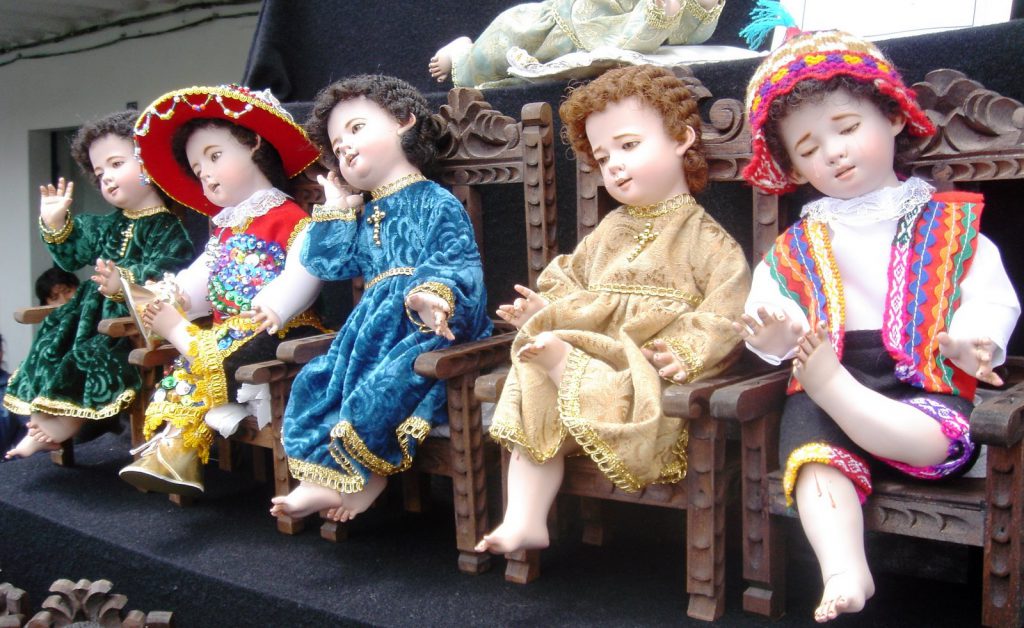
His work reached international fame for his images of baby Jesus with a sweet face and pink cheeks, but also has other peculiar characteristics: mirror palate, glass eyes and natural hair that have become today the reference of other contemporary artisans.
Don Antonio Olave was known as the «Father of the Child of the Thorn», an image of the Infant Jesus that carries a thorn on one of the feet and a tear of glass finished with surgeon’s precision.
The Olave Art Gallery can be visited at Cuesta de San Blas 651, Cusco – Peru.
At Casa San Blas Boutique we are proud of our cultural manifestations and the work of our great artists, that’s why we recommend visits to these popular art galleries that are within walking distance of our boutique hotel.
Peculiar Streets in Cusco
We invite you to discover the brief story behind seven streets with peculiar names in Cusco.
These streets are located in downtown Cusco and are easy to find.
While you enjoy your stay at Casa San Blas Boutique, hotel in Cusco, do not miss the opportunity to visit them.
Calle Ataud (Coffin Street)
According to the chronicles of Cusco, the Inca General Atau Qilacu Yupanqui, whose conquests were legendary, inhabited the last house that can be seen from the beginning of this street. In the stone lintel of the same two snakes are carved in an attitude of attack.
During the colonial times, the street acquired that name due to its narrowness and gloomy appearance; as well as an urban legend that tells of a walking coffin that appeared on this street scaring pedestrians.
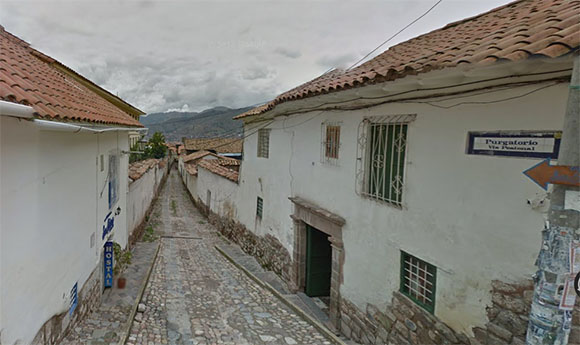
Calle Purgatorio (Purgatory Street)
Another urban legend gives name to this street. It is said that this was inhabited by an old grumpy woman who, even after death, roomed the house, letting shouts and chilling noises to the neighbors.
It is said that the son of the deceased used to place a box at the front door of the house with the label “a handout for the souls of purgatory”
Calle Amargura (Bitterness Street)
This is a cobbled street, where it is said that the conquerors made the natives let the stones they took out from Sacsayhuaman roll for the construction of the Main Square and the Cathedral of Cusco. This work was hard and painful for the natives, who often suffered accidents. For this reason, the street was called «Mucchuicata» (in Qechua), which translated into Spanish means «BItterness Street».
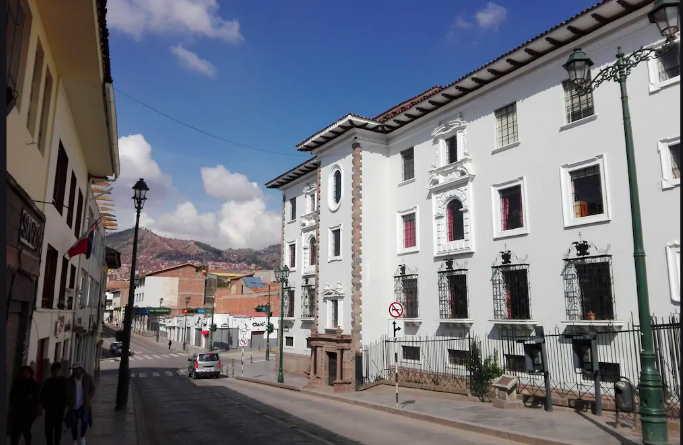
Calle Afligidos (Afflicted Street)
This street is located next to what is now the Court House. It is said that formerly, in this street the bodies of the executed were exhibited, whose relatives made demonstrations of pain.
It is also said that many citizens in search of justice gathered in this place to tell their afflictions.
Calle Mira Calcetas (Stocking Street)
This is the name of a narrow, small and poorly paved street where passers-by, especially women, make it difficult to walk.
It is said that formerly women had to pick up their long dresses to avoid tripping by allowing them not only to let other people see their socks (stockings) but also their calves, provoking roguish comments from the men.
Calle Desamparados (Helpless Street)
In the mid-twentieth century, Mr. Alfonso Cortes Montoy, ordered to put on the lintel of the house where he lived, a small image of Our Lady of the Helpless, to whom he had a lot of devotion.
This image remained in place until the day of the great earthquake of the year 1950, remaining since that time only the name of the street.
Calle Abracitos (Hugging Street)
It is said that Mr. Juan José Ricalde, upon making his triumphal entry into Cusco as the new Corregidor of the city, was welcomed with flowers. Two wealthy ladies in order to show their importance began throwing sealed and carved silver coins. One of these coins ended up slitting his head. The lady who caused such an accident hastened to apologize by hugging him repeatedly.
At Casa San Blas Boutique we are proud of our culture and are ambassadors of our traditions and our genuine Peruvian hospitality.
Ten Reasons to Visit or Return to Cusco
For those of us who have had the privilege of visiting Cusco, the reasons are too many to return to this magical city whenever possible.
Cusco is not only the most cosmopolitan city of Peru because of the interesting mix of its demographics, but also because of the floating population it hosts (the thousands of travelers that arrive daily through its different air and land terminals).
Walking through Cusco is a pleasure, it’s a discovery, it’s an experience, it’s an adventure, it’s magic.
Here we present 10 reasons why visiting and/or returning to Cusco will always be worth it.
1. You will always feel its energy
When you arrive in Cusco you feel something special. Something that can not be explained with words.
Maybe it’s the excitement of reaching a long-awaited place. The memories saved in your previous visit, the majesty of its pre-Columbian constructions, the warmth of its people or the feeling of standing in the navel of the world … that one feels simply different.
2. You will never finish knowing it!
There is so much to see and so much to learn in a single destination that you never stop surprising: archaeological remains, natural wonders, communities with ancestral traditions, millenary rituals, amazing stories, magical places, bizarre characters, hidden places, lost steps. All this is Cusco.
3. You can combine interests of different types.
Cusco is a great place to do everything: start a business, receive training or come to share your knowledge, travel with your family, escape with friends, give yourself a well-deserved rest, do adventure sports or venture to do something daring, visit museums, appreciate art, breathe culture, make friends, lose yourself in nightclubs, become spiritual or practice your spirituality. The list goes on …
4. Everything is «handy»
Who needs a car to enjoy or visit Cusco?
Your feet are your best vehicle because everything is close. Walking makes you feel alive, especially when there is so much to do, so much to discover … every little corner becomes a discovery.
If the high altitude starts reducing you energy levels, public transportation is the best. Taxis are cheap (almost impossible to believe), the bus or the «combi» are even cheaper and come loaded with anecdotes, local flavor, folcklore …
5. Eating is a pleasure
Eating is a pleasure and the Cusquenians know it well.
If this is your first visit, analyze the behavior of the residents. Cusquenians enjoy coffee many times a day, eating in restaurants and, above all, paying a fare price.
Where residents eat, you will also eat well.
There are restaurants, eateries and coffee shops for all tastes and all budgets.
It is always recommended to enter a place of high turnover. It will not be difficult to know where.
6. Fun is guaranteed
You’ve already heard about the inexhaustible nightlife of Cusco. Its bars and squares are the meeting point for night owls who gather to plan the night’s tour.
From seven in the evening, around the Main Square, the so-called «jaladores» are responsible for distributing cards with free admission and courtesy drinks encouraging everyone to stop by their clubs.
It is always advisable to know where to go. Check the comments of Trip Advisor, be encouraged to visit the different fun options.
But, as in any parts of the world, try to be accompanied, because «fun between two is always better.»
7. People are very communicative
The Cusquenians are very kind, especially those who work in Tourism, which are more than half of the population (directly or indirectly).
Most of them practice a genuine hospitality that is strongly felt in their desire to help travelers.
The population from the highlands (those who live in the remote communities) who sometimes come down to the city to buy supplies or do some other things are shy, hiding a pure sweetness, especially the children.
If you see a native child from the Andes and you want to do something special for him/her, please do not buy him/her candies, buy a coloring book and some pencil-colors, it’s the best gift you can give them.
8. You feel belonging
There is a very Peruvian saying «the world is wide and foreign». When you visit Cusco, you realize that it is possible that the world is wide but the more you travel it, the more it becomes yours.
There is no traveler who does not feel in his heart that a part of him/her stays in Cusco and a part of Cusco goes along with him/her at times of departure.
It’s a special feeling that does not make sense until you’re here.
9. You live art everywhere
In Cusco you breathe art wherever you go. Its constructions, its music, its dances, its food, its customs, the magic-religious syncretism that finds no better showcase than in the plastic arts and crafts.
Give yourself the chance of walking as much as you can and discover the surprises that Cusco has reserved for the intrepid.
10. You get to like «the affection»
In Cusco you feel «beautiful». The Cusquenians are famous for referring each other with affectionate words like «cholito», «papicha», «waykicha», «mamacita», «reina».
There is no place in the world where strangers treat you with more affection.
At Casa San Blas Boutique, hotel in Cusco, we are proud of our culture and of being accomplices of your adventure.
San Blas Quarter
San Blas, also known as the artisans’ quarter, is undoubtedly one of the favorite places for travelers to explore the city.
Its narrow cobbled streets, its white painted houses, coffee shops, restaurants, art galleries and small shops, as well as the sympathy of its inhabitants, attract everyone inspiring feelings and passions.
San Blas was the birthplace of well-known artists such as Don Hilario Mendivil (creator of elongated neck imagery), Don Antonio Olave (famous for his images of saints, virgins, child Jesus and archangels) and Don Edilberto Mérida (famous for his creations of clay that portray peasants, musicians, mythological and universal beings).
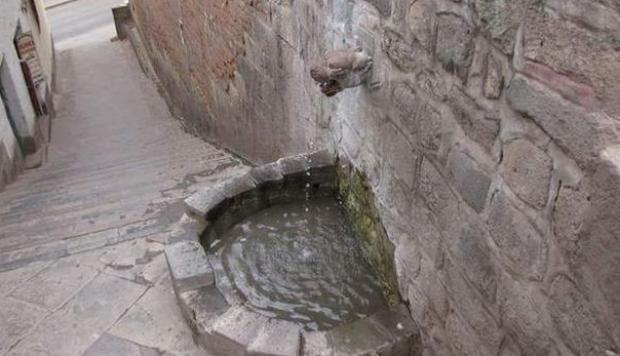
But the history of this neighborhood is even older. During the time of the Incas it was called Toqocachi, or «Salt cave» and since that time it was inhabited by farmers and artisans. They say that the neighborhood had abundant water from springs, an excellent microclimate and obviously the elevation of the land allowing a wonderful view of the valley of Cusco.
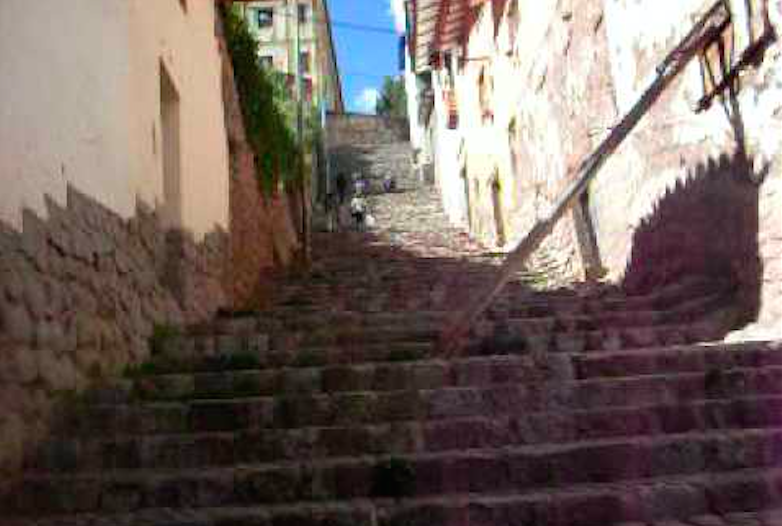
Its urban layout dates back to the Incan timea. Streets like Tandapata, were part of the famous Inca trail towards the east (called Antisuyo). According to historical records, streets such as Atoqsayk’uchi, Chiwanpata and Recoleta were part of the secondary trails.
After the arrival of the Spaniards, the Church of San Blas was built, giving its name to the traditional neighborhood of peculiar streets such as:
Siete Angelitos (Seven Little Angels), on the right hand side of Carmen Alto street. In the eaves of the second house of this street are painted seven faces of angels, who were sent to paint by order of Blas de Bobadilla, owner of the house.
Siete Culebras (Seven Snakes) or Amarucata, where are engraved in stone, seven snakes in high relief on the wall of the so-called Yachay Wasi or House of Knowledge.
Siete Diablitos (Seven Little Demons), which is a narrow and secluded street where, according to the chronicles, the lovers who were tempted by the devil and often returned home with a «Sunday 7», an expression widely used to refer to «not desired situations».
Toqsayk’uchi, which means «the path of the fox» and refers to a character from the Andean mythology that unites the world above (Hanan Pacha, the world of the gods) with the world below (Kay Pacha, the world of men).
Siete Ventanas (Seven Windows), whose name comes from the existence of a house on the corner of Alabado street, belonging to the Convent of San Agustín that had 4 large windows and 3 small windows from which it is said that the novices watched the young handsome boys.
San Blas is full of bizarre and funny stories that Casa San Blas Boutique likes to share.
The Art of Weaving in the Andes
There are andean towns that still preserve their customs, mainly rural places. Andean cultures have developed techniques that are still used now, one of them is the textile art. Since the ancestors, many people around the world indicate that the tissues of the Paracas culture were the best in its field. The textile art of the Paracas is one of the finest and most sophisticated in the world. They are well regarded for their designs, variety of colors, fibers and pigments, and especially the techniques used in its preparation. These looms were used in their famous funeral bundles.
So these techniques came to the Inca culture, in which people used the same techniques. Because in those days there were no textile industries we know today, they had to resort to the wool of their Andean camelids (llamas, alpacas and vicunas), then use natural pigments and dyeing these fibers. Finally with all these techniques they were weaving their own clothes. The colors were and still are the result of natural pigments extracted from minerals and vegetables. The best woven fibers, garments which would then be used in important rituals and ceremonias.
Talking about the designs, most of the drawings were with geometric shapes, offering original, complex and colorful creations in representing forms of their daily lives. They used to be motifs of flora and fauna.
Many of these ancient traditions mixed with new technologies and techniques used to fashion; they are today conquer the demands of foreings; in Casa San Blas Boutique, hotel in Cusco we intend to put our guests in contact with this representative aspect of our culture: the ancient and contemporary textiles. Travelling involves a learning opportunity, in our hotel we combine our hospitality with textile art and make this an experience of a different hotel.
Inside the hotel you will find plenty of Andean textiles, all are from cusquenian Andean communities, because we are determined to support the sustainable development of our region.
Welcome to Casa San Blas Boutique, hotel in Cusco a new way to learn at a themed hotel.
The Tradition of Chaku
Peruvian vicunas, alpacas and llamas are animals with great value. Currently their wool is very used for the production of textiles, mostly clothing. Because of its great value, laws protect them from hunting, shearing and subsequent sale of their meat now protect these animals.
The Chaku is an ancient Inca practice of confinement, capture, shearing and subsequent release of wild vicunas living in the place. The Inca Garcilaso de la Vega mentions in his book: The Royal Commentaries of the Incas «the great chaku that made the Incas Lords».
The Incas were owners of greater intelligence, every act that was carried out respecting the Pachamama or Mother Earth. Moreover even the animals, this explains the Chaku. A tradition that was carried out every three years in Inca times. A group of people in each village began to surround large areas to form a human chain so they can herd the animals into stone corrals. There the count was performed and the animals were selected which would be used for consumption and the other for the sheared.
The Family behind Casa San Blas Boutique has a longstanding relationship with textiles in the Sacred Valley of Cusco. This story goes back to 1937 when Delia Milla Vidal, decided to combine the techniques of contemporary Andean textiles with an artistic touch after publishing her book «Textile Art in the Andes».
Casa San Blas we intend to put our guests in contact one of the most representative aspects of our cultural heritage: The ancient and contemporary textiles.
Traveling involves a learning opportunity. Therefore, we combine our traditional hospitality with textile art in an educational theme. To enjoy the colorful design of the pieces of art that decorate our premises, you will learn about the processes, and be transported to a complex world of beliefs and Inca wisdom.
Tiny Bulls Protecting Your Life
Before I start telling this beautiful story about these animals, I’m sure you already have seen them before, especially in Peru. If you have not seen, stop for a moment, look up, look for the housetops, and find a couple of small bulls made with ceramic (clay). Some use them as ornaments in the home, but most are in the ceilings. These bulls have a meaning for each family.
The bulls of Pucara represent prosperity, happiness and fertility. They are also protecting the welfare and good luck. The fact that each family put it on top of their homes is because they represent a family protection.
The bulls were not native animals of Peru. The Spanish introduced them to our culture. The strength of these animals surprised the villagers of Pucara, located 101 km north of the department of Puno. And so they put him immediately in their customs and rites that were performed in the area.
Thus, in Pucara an ancient feast of Spanish origin in which the bull was decorated, painted, put a saddle and a spicy frui ton his nose. The bull, with wide eyes and the desire to want to get rid of spiciness, was very strong but not achieved its purpose. This image of bull fighting for its tranquility The image was set out in the minds of the villagers and from there began to buy it as a symbol of strength and protection.
From our terrace, a quiet place at the top of Casa San Blas Boutique, you can see a lot of roofs of our city. Stop for a moment on the terrace and look for the small bulls above the roofs. You’ll see many of them, and they are all different!
Veneration of Señor de los Temblores
The history of Señor de los Temblores (Lord of Tremors) remote to the time of the colony, when in 1620 was worked a different Christ for those who venerate in Spain, with the purpose of consolidating the process of evangelization in Peru, to complete this goal the Christ must have coppery color and mestizo features.
The image was a gift from the King Carlos and to send across the ocean in a closed ark, in the middle of the trip when a storm threatened the crew, the image of Christ was taken. The religious people put the crucifix on the mast of the ship and prayed. The storms stopped and calm the fury of the sea, reason why travelers decorated to the image of Christ as “Lord of Storms».
When the image arrived to Peru, it was designated to a Spanish muleteer to move the image to the city of Cusco, after many circumstances the image arrived to Mollepata in the province of Anta, department of Cusco and just when they intended to continue with the trip the image of Christ weighed too much, so that the town interpreted this fact as a divine purpose ash that «Christ wanted to stay» over time was built a temple and was baptized as «Lord Manuel Exaltación of Mollepata» and and actually is known as such in the province of Anta.
The past chronicles tell that after the disastrous earthquake occurred on March 31th, 1650. Reason why it was baptized as the «Señor de los Temblores».
Also, the history tells that the holy image was taken in procession in 1720, because the plague was struck to the population, stopping the disease. Before this miracle, the population proclaimed it «Jury Pattern of Cusco».
In the present day the image of the Lord of the Tremors is in the Cathedral of Cusco with features less thin and hard, with rough but shocking anatomy, the image was worked secretly in complete the king’s order, since the original stayed in distant lands as Mollepata u the province of Anta.
It say that the color of his skin changes by the smoke and the contact of the resin of the Ñuqch’u, a sacred flower that symbolizes the blood of the «Pachamama or the Mother earth» in the magic Andean religious world. From the year 1741 he leaves in procession every Holy Monday in order to bless all people that live in Cusco.
Festivity of Señor de Torrechayoc
They say that in the mid-twentieth century, worship began to a Cross that had been placed in the middle of the snow.
It is said that travelers and passers-by near the cross had dreams in which the Lord of the Cross told them about the intense cold that he had in the place. The comments of these dreams came to the ears of the parish priest of a nearby community who made all the arrangements for transfering of the cross to Urubamba where his cult grew until he appointed Lord of Torrechayoc, Lord of the province of Urubamba, in the Valley Sacred of the Incas.
The celebrations in homage to the Lord of Torrechayoc, begin approximately the second week of May (generally a Saturday), in which different activities are programmed, among them a Mass that is celebrated in a sports stadium due to the quantity of people who arrive to the town, impossible to fit in a church.
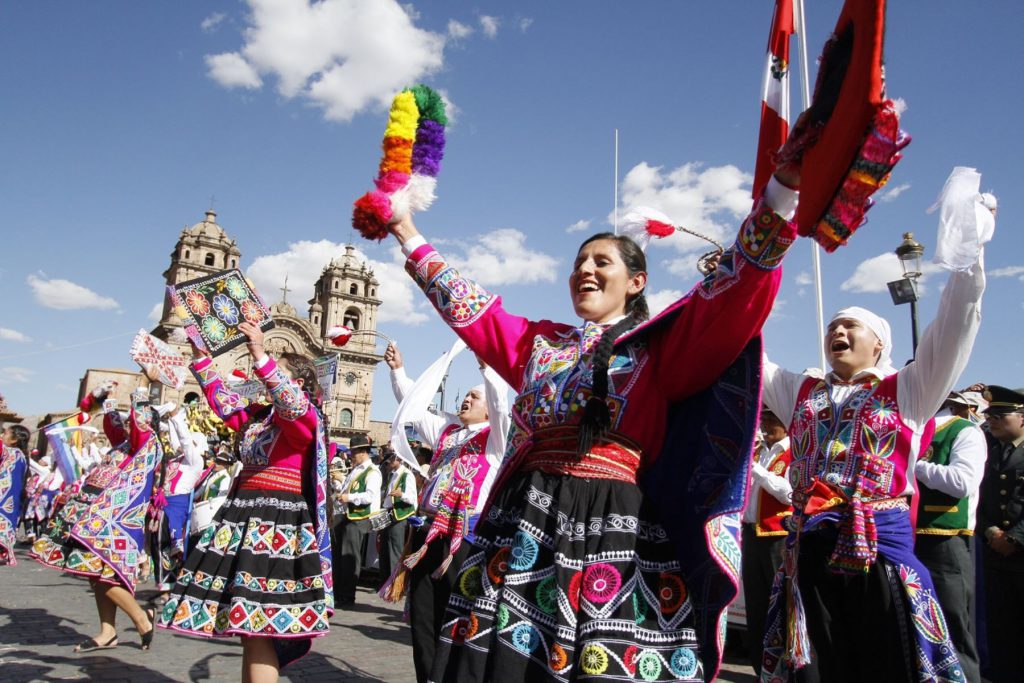
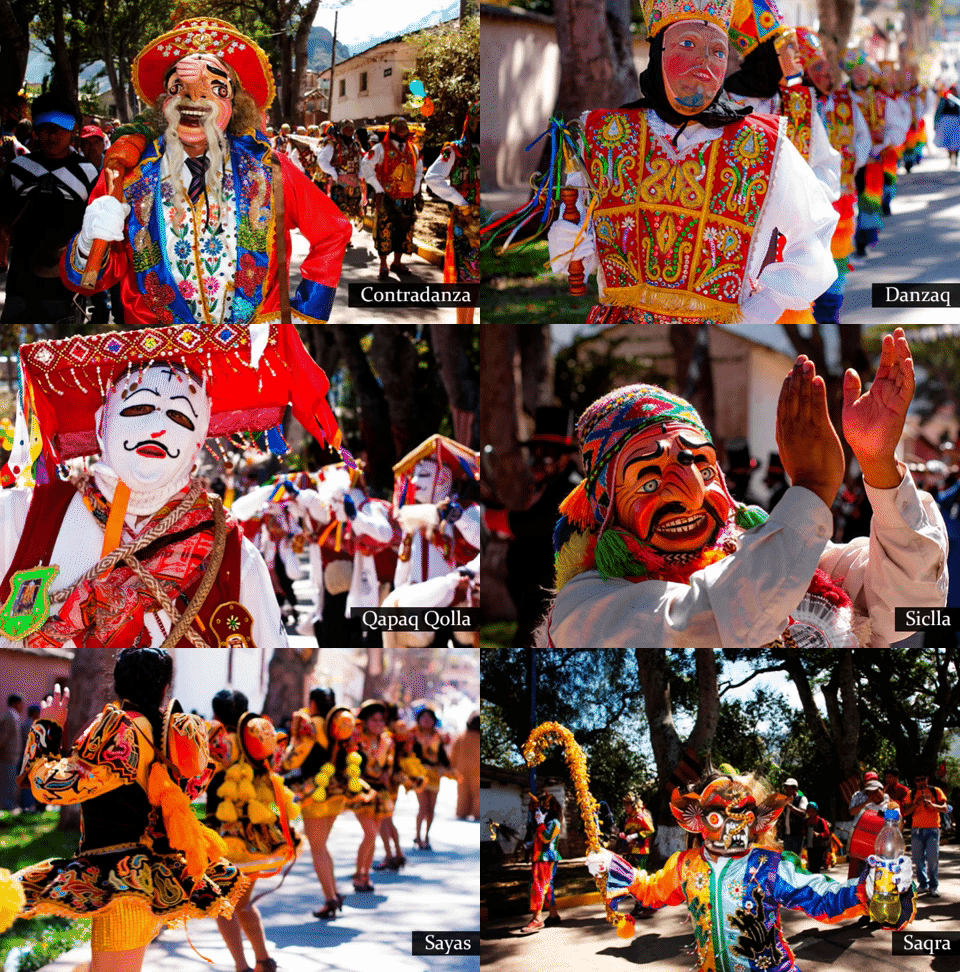
After Mass a colorful parade with different typical dances organized by groups of faithful takes place.
As night enters, the sky is lit with fireworks, a result of the burning of fireworks castles.
The following day, the Cross of the Lord of Torrechayoc, goes out in procession through the main streets of Urubamba, in a colorful tour, full of music, dance and abundant faith.
If you want to be part of this traditional festivity and witness the religious syncretism that abounds in the religious festivals of Peru, do not forget to:
Get the holiday program updated with the schedule of activities.
Pack a small backpack with sunglasses, hat and sun block (solar radiation in the saw is very strong).
Enlist your camera in advance. Clear your memory card and charge the battery (if possible take an extra one)
Do not lose sight of your personal belongings. You will be in a very busy area, so you must be attentive to make sure you do not lose any object, especially those of value.
If you are accompanied by friends, it is recommended to define a meeting point to meet in case they separate and enjoy the party without any fuss.